Thinking and Writing Well with AI is Hard
First it seemed like AI was the gift to forever eliminating writer's block, tapping down fear of the blank page, and creating a first outline. After working with AI over the past year as a writing partner, I can tell you one thing. It is harder than it looks to generate good writing. In fact, after a full year of using AI as a thinking and writing partner, I honestly can't say if it is actually saving me time. Initially, I thought it was. It really depends on what I'm using it for.
That's not the sales pitch you usually hear about AI. But understanding why it's hard turns out to matter a lot for us as adults, and even more for our kids.
How writing is supposed to work
A simple framework to describe the thinking process required to write well is Bloom's Taxonomy. Researchers debate this framework in various ways, but it's a useful map of how thinking builds. Bloom's Taxonomy has six levels:
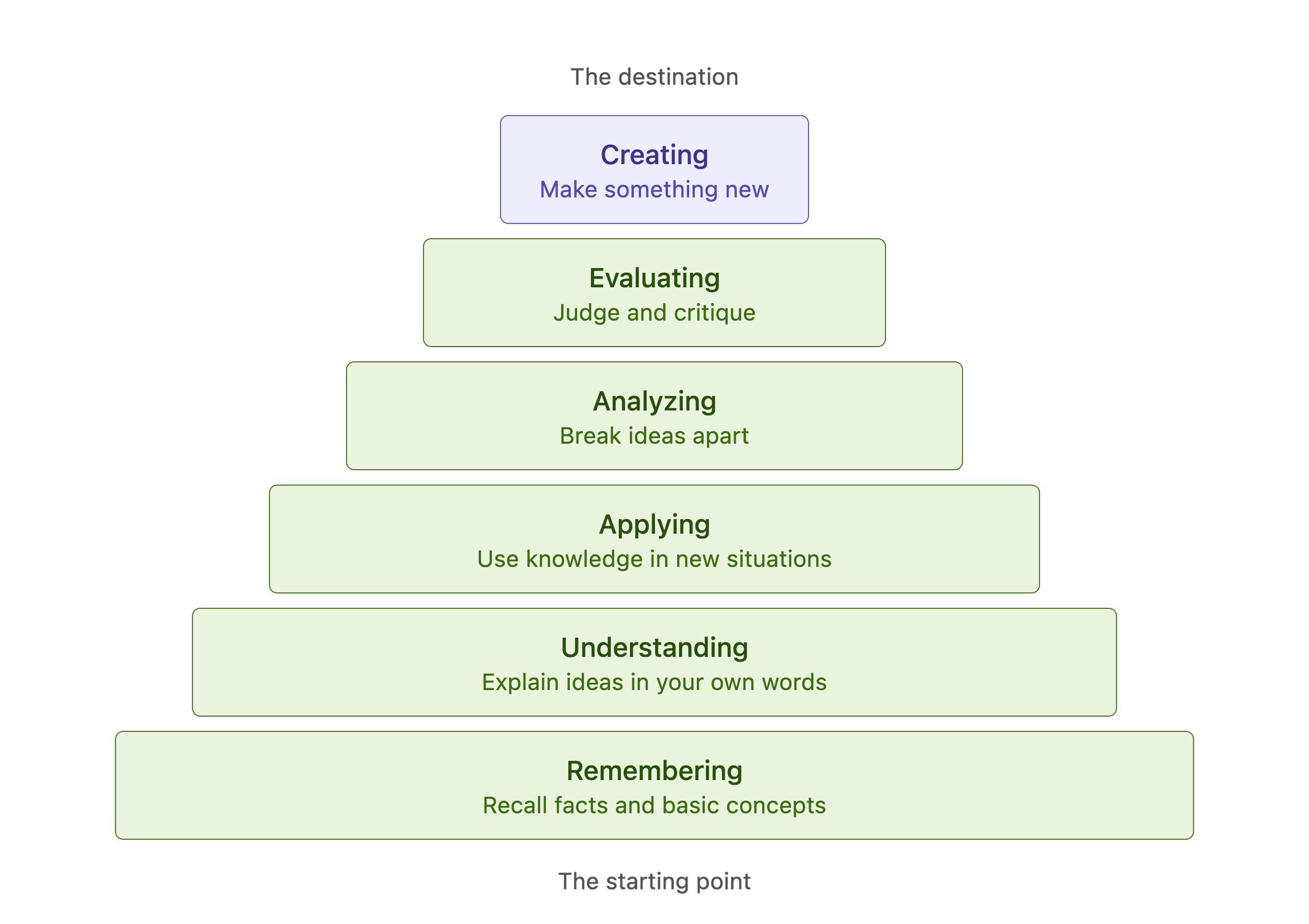
For years, we've talked about starting with remembering and eventually reaching creating. Learning each of the steps requires new skills and lots of practice. It takes years to build and polish these skills. And much of the K-12 curriculum is designed, maybe not explicitly, to build and expand these levels in the order presented above. Creating original writing and original thinking sits at the top because it's the hardest and everything below it is the foundation.
AI flips the pyramid
Thinking and writing with AI requires a different approach, because Creating becomes the first step rather than the top of the pyramid. By flipping Bloom's Taxonomy on its head, writing with AI forces us to use these skills in a whole new order than we did before.
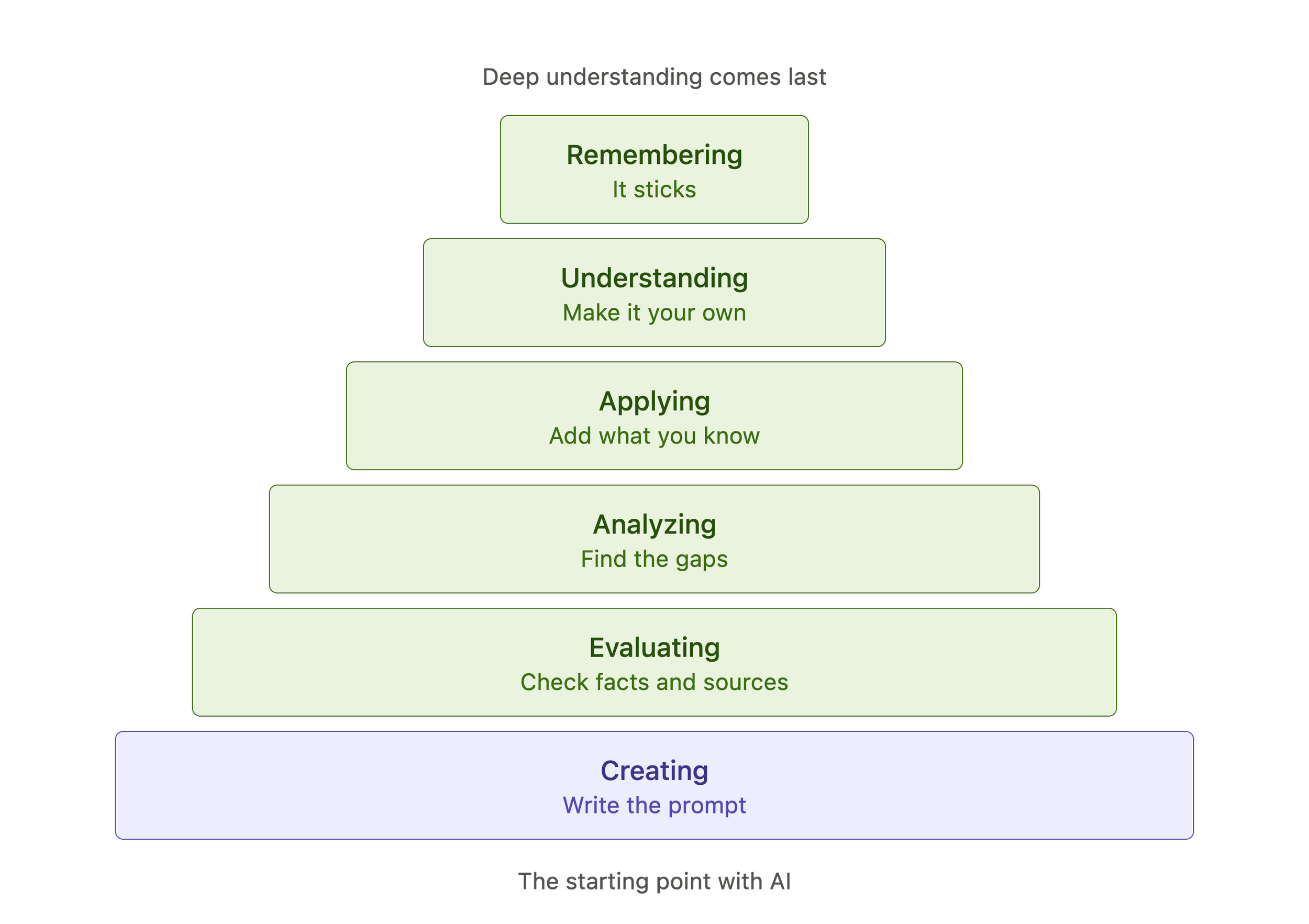
But here's the important thing. The flip only happens if you make it happen.
There are really two ways to write with AI. In one, you give it a prompt, get output, skim it, and call it done. Call that unstructured AI use. In the other, you treat the output as raw material that has to pass through your own judgment before it counts as finished. You have to check claims, find gaps, and rewrite in your own voice. Call that structured AI use.
The difference isn't how much AI you use. It's where the thinking happens. In structured use, the thinking moves from the drafting stage to the evaluating stage. In unstructured use, the thinking doesn’t happen. You didn't generate the ideas and you didn't question them either.
So what does structured use actually look like? It looks like running Bloom's Taxonomy in reverse, step by step.
Step one: Creating (yes, prompting counts)
Creating with AI means spending time generating a prompt if you even want the initial output to be good at all. If the prompting is done poorly, the written output from AI will sound excellent, but it will most likely lack any substance. That's the signature of a weak prompt.
Say, though, I write a detailed prompt from the start. What happens next?
Step two: Evaluating
The AI output will help you avoid writer's block and the challenge of starting with a blank sheet of paper. But the next required step is to evaluate the output to make sure there are no hallucinations or falsehoods. AI is known to hallucinate. And since the content didn't all come from you and your knowledge of the facts, you have to double-check its validity by checking citations and even checking the content itself.
The core issue is that AI cannot verify its own output. That job always falls to the human. (If you want the deeper explanation of why, I've written about it before in "Why AI Gets It Wrong.")
Step three: Analyzing and applying — the gap analysis
Step two asks the question “is this true?”. Step three asks a harder question. Is this any good?
Even when every fact checks out, AI output tends toward the generic argument that anyone could make, not the case you would make. Finding the distance between those two is the gap analysis. This is where you act like a lawyer preparing for trial and interrogate the draft. What's the strongest objection a skeptical reader would raise, and does the draft answer it? What key evidence or example is missing? Which sentences are doing real work, and which just sound good? And the big one is whether it is actually my argument or the average of everyone's?
Poking holes in thinking is a critical thinking skill and a hard one to learn. I didn't hone it until graduate school, where we were constantly asked to identify the strengths and weaknesses of research studies. Most people never get that training at all.
So, what surprises me most about writing with AI is that when it is done right, it forces exactly this practice. When I write my own essay, I believe my own sentences by default. Nobody makes me hunt for holes in my own argument. AI output arrives untrusted, so interrogating it is the whole job. And through that interrogation, something important happens. The argument stops being AI's and becomes yours. You understand it because you stress-tested it. Skip the interrogation and the opposite happens. You hand in words you never engaged with, don't fully understand, and won't remember.
I'll be honest that even with training and experience, this is the hardest step. Sometimes no AI at all would have been the better choice. It continues to be a learning curve.
Now, about our kids
With my kids in 6th and 8th grade, this is not an abstract question for me.
My biggest worry isn't that kids will lose critical thinking skills to AI. It's that they'll never build them. An 8th grader who leans on AI isn't losing anything, but they're skipping the years of slow, hard practice where those skills would have formed.
And kids will take the easiest route. That's not a character flaw, that's being human. Building skills, especially critical thinking skills, is hard and takes time. Pasting a prompt and getting immediate AI output are neither hard or time-consuming.
That's why I believe K-8 writing should stay mostly AI-free. Kids need to climb Bloom's Taxonomy the original way, from Remembering all the way up to Creating, before they're ready to run it in reverse. Then in high school, students need to learn both modes, independent writing and AI-supported writing, and how to switch between them. I disagree with banning AI in classrooms entirely, but if we don't help high schoolers learn this new way of thinking and writing, they'll simply start using AI in college in ways that will shape how and whether they learn.
Schools and teachers have a huge role here. But curriculum change is slow, and our kids are in school now.
So where do you, as a parent, come in?
You need to learn how to do all of this first either in your work or through the general writing you do for home tasks. You can't coach a skill you've never practiced. (That's what this blog is for.)
When you do that, you can bring AI-focused thinking to your kids. And you don't need to be technical to do it. Here's a test that takes two minutes to check if your kids are using AI to write. Ask your kid to defend one claim from an essay they wrote without looking at it. Where did the claim come from? Why is it true? What would someone say against it? If they can answer, the thinking happened. If they can't, the AI did the thinking and your kid did the copying and pasting. You can then have a conversation with them about learning and structured AI use.
The hard, necessary part
This isn't easy to do since it requires us to transform how we teach writing, both independently and with AI. But it is necessary. For those of us using AI to write, it continues to be a learning curve. We want to use AI as an effective writing partner, not a crappy one.
Our kids don't have a year to wait for us to figure it out. In the next post, I'll get concrete about how you, as a parent, can help your kids build healthy AI habits by using questions to start to build their own skills in structured AI use.
A Note on Process
I used Claude and ChatGPT to help draft and refine this post. My process was that I provided a draft blog post Then I worked with the AI tools as collaborative editors by going back and forth to help me shape the ideas and language.
